
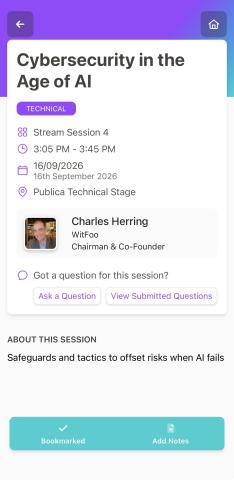
I spoke at Canterbury Tech Summit yesterday about cybersecurity in the age of AI. The event app let attendees submit questions during the session and vote up the ones they wanted answered, and by the time the clock ran out there were fifteen sitting in the queue.
I got to some of them live. A few of those answers were good. Several were not, and at least two were outright punts. That has been bothering me since, so here is the whole queue, in the order the room voted for them, with the answers I should have given.
Questions appear exactly as they were submitted. Thank you to everyone who asked one.
1. Favorite passphrase
What's your favorite passphrase?
Karl L.
It is wiser not to answer this, but it is actually searchable on the internet anyway. If you go to a site like Have I Been Pwned, or dig through the data dumps, you will find a recurring pattern: H8lazy#s ("hate lazy pounds"). I don't use it anymore, but I used it a lot, particularly in the oughts.
2. Will the rate of CVEs drop?
Do you expect the rate of CVEs to drop as people 'catch up' and use AI to help address both existing and future systems?
David W.
I do expect it to normalize for most production code as we dig through the last few decades of backlogged vulnerabilities.
The counterpoint that may stretch that cycle out is that more people are writing more code without thinking security through. Vibe coding adds volume faster than it adds rigor. The hope is that AI generation also starts producing more secure code, which would reduce vulnerabilities at the front end.
Short answer: yes, I think we will see patching slow down once we get through the last two or three decades of backlog.
3. Convincing end users that the controls help
How do I convince end users that my paranoia and security controls are actually helpful and to please not write passwords on sticky notes?
Celeste T.
Celeste, I didn't give you a great answer on the day. Here is a better one: try to move your users off passwords and onto passkeys. They are easier for users to maintain. Setup is a little more complicated, but it ends the conversation going forward, and it is more secure.
And if it would help for me to come in and give your users a talk and scare them to death, I am happy to assist with that as well.
4. Supply chain attacks under daily patching
With daily patch deployment, how are you protecting yourself from supply chain attacks?
Steven S.
Steven, on the day I gave you half of this answer, which is what I call the nuclear fork. That post walks through how to bring open source libraries in house and protect everything downstream of them in your code.
The half I didn't answer is the products we buy. What about Microsoft Office needing a patch, and that patch being part of the supply chain? That is where defense in depth comes in. We are not going to catch everything with patch management. We have to rely on the other controls to catch what slips through the cracks: the firewalls, the endpoint protection, and the analytics.
I hope that helps.
5. Establishing that someone is who they say they are
Knowing your staff has been an issue forever, 30 years ago it was as easy as two pieces of letter headed paper to create a new identity, how do you ensure someone's identity now?
Bill W.
Bill, I gave you something close to a non-answer on the day. Thinking about it since, there are a few things we can do. They are just a little onerous.
The main one is running outsourced background checks that cover both criminal history and credit history.
Forging a document to hand to me is one thing. Forging the paper trail behind it is another: opening bank accounts and utility accounts, running transactions through them, and building a credit history underneath it all is a far more elaborate fraud and a much harder one. There are more checks to get through.
It is a bit discouraging to need official criminal and credit checks on every employee, but those checks do help establish that the person you are hiring is a real person.
6. Open weights versus closed models
Where do you stand on the Open Weight/Source vs closed when it comes to Cybersecurity? Is it better to have open intelligence or too dangerous?
Detroit T.
When choosing models, there are two things I look at.
Where the data goes. Are we sending information out of our networks and into someone else's, and what care are they giving our data? There is a good argument for data sovereignty: models held internally, or held by trusted partners under tight definitions of how our information is protected. That may well be an open source or open weight model running on our own hardware. The challenge is that we then maintain the infrastructure, the tooling, and the harness ourselves. The benefit is that we are in complete control of the protections around data going to the model.
How the model was trained, and what biases it carries. There is an argument that overseas models, particularly Chinese ones, have something nefarious in them. I have not seen evidence of that. Every model has some level of bias, though. When evaluating one, start by understanding and testing for those biases, then fine-tune whatever you select to your specific use cases and to minimize the biases that run against your organization's values.
Those are the two big ones: solve for data sovereignty, and solve for bias in the models. The cost of bringing it all in house is that you handle the tooling and you make the capital expenditure on the GPUs. The frontier models have far more feature availability out earlier, so you have to be content with a smaller feature set in exchange for the security.
7. ID requirements for social media
Thoughts on ID required for social media?
Francis A.
Francis, this is a great question, and it is more a political one than a technical one.
I have been on the internet for most of my life. In the early days there was a clear line between an online identity and a real-life persona. The two really did not interact. Over the last three decades those worlds have become very connected. We use our real faces and our real names, and we make decisions about what we do in real life based on the people we see and what they say to us, whether they are close acquaintances or experts we respect.
There is an argument for giving us some options to verify that the persona we see digitally matches the real person behind it. It removes a lot of danger, particularly for vulnerable audiences. We do not want children exposed to someone posing as a peer who is nothing of the sort.
In some cases I think identification is critical. At minimum, once we get into transactions, we should have a mechanism to request verification of an ID. On Facebook Marketplace it would be good to be able to verify identity on both the buyer and the seller side. Maybe it is not on all the time, but it is something that can be presented during a transaction or another vulnerable interaction.
The reason this is political is that the more we attribute activity to verified IDs, the safer things can potentially become, but we buy that safety by surrendering some privacy to whoever manages those IDs. I would like to see more done, and more options available to us, to verify the identities of people online. I also think it has to be done carefully, in a way that respects the privacy of all the parties involved.
8. Favourite Trek series
Favourite Trek series? (TOS, TNG, Voyager, etc)
Ian C.
Ian, I love this question. My favorite Star Trek series is Deep Space Nine, and it is not only my favorite Star Trek series, it is my favorite television series of all time. I watch all seven seasons through at least every other year. I am wrapping up season six right now, probably on my tenth pass.
It did a fantastic job of character development, and it took on social questions that only science fiction can really get at.
One more thing worth pointing out: Deep Space Nine was the first real prime-time show to break out with multi-episode plotlines that were not good for syndication. Those arcs became the beginning of the ideas behind shows like Game of Thrones, which run as one long story instead of compressing the whole story into a single episode.
I have a ton of respect for the people behind Deep Space Nine. I know it is not the popular opinion, but I think it is probably the best of the series, and one of the most fantastic things we have done as human beings.
9. An interesting attack
Do you have an example of an interesting cyber attack and what made it interesting?
Keren H.
As I mentioned on the day, the most interesting attacks in cybersecurity have less to do with computers and more to do with people. Cybercrime is just crime where we are using computers in some part of the attack. The way Edward Snowden took information out of the NSA on a thumb drive, and what motivated him to do it, is far more interesting to me than any particular exploit against a firewall or a service.
Once you start looking at the human part of cybersecurity, it is simply more interesting. There are more dimensions: love, loneliness, greed, political conviction. Some attackers are doing it for what they believe is the greater good. Some are motivated by greed. Some are motivated by fear.
Any study of how computers were used to manipulate the behavior of human beings tends to be as fascinating as it is heartbreaking.
10. What annoys me about my industry
What's something that annoys you about your industry?
Jade S.
Jade, that is a great question. I have spent most of the last ten years trying to encourage people to work together and collaborate.
The problem is that thirty years of specialization has split cybersecurity into a lot of separate jobs. It is not one profession. There are auditors, regulators, SOC analysts, incident responders, law enforcement, and insurers. There are more than forty career paths covering different cybersecurity workloads, and each one speaks its own language and has its own norms. As a result, we have not figured out how to work together well.
Most of my research is about taking someone who works in insurance and enabling them to do that work in a way that respects what law enforcement, the SOC analysts, the engineers, and the people funding all of it are doing. They really do not understand each other, and that lack of understanding leads to a lack of empathy. The lack of empathy creates conflict, the conflict creates trauma, and the trauma builds walls.
How we stop fighting one another, put our energy toward the attacker, and find new ways to work together is where I spend most of my waking hours.
11. IoT at home
Do you use any IOT in your home?
Alyssa J.
I do have some devices, like security cameras and smart TVs, but as a rule I try to be more analog where I can be. It is easier to interact with and more tactile.
The Internet of Things devices on my network sit on their own segment, and they cannot interact with the computers my family uses. I am paranoid about it, and I keep less of it around. Anything I bring onto my network that I do not fully understand goes into an isolated segment where it cannot play with the other parts.
12. How long AI controls stay valid
How good can be the AI controls and how long they can stay valid for since its just ever changing at this stage. How often they should be revisited?
Shafali V.
Controls do evolve over time. A firewall works differently today than it did fifteen years ago, but what we use it for stays pretty static.
Evaluating the efficiency of the controls, meaning whether they are actually working, should be ongoing rather than periodic. Some of the research we have done, and some of the products we make available to our customers and partners, will raise an alarm when coverage changes: we had malware protection across a segment, and now it is missing somewhere. It is a way of alerting when the controls break down.
It is a complicated problem, but it is a manageable one.
13. Security risks in Copilot agents
What security risks are associated with agents created in Copilot, and how vulnerable are they to attacks?
Jodh S.
That is a great question. I have not looked at what the out-of-the-box settings are from Microsoft. I do know they are prioritizing safety in the harness. But as we give any agent more access, Copilot included, we are potentially giving that access to an attacker who gains control of it.
It is worth working with Microsoft and with partners to run a risk assessment on how things are currently configured, attempting to mitigate what you find, and reviewing those risk plans as you make changes or add new capabilities.
That is a somewhat unsatisfying answer, but the honest one is that it depends on how it has been configured. Looking at the risk profile of your configuration and applying a zero-trust ideal to it is the best practice.
14. Forging digital assets
When you say "forging digital assets is easier than ever" (such as a passport), is this specifically because of AI?
Travis H.
Travis, yes, that is right. Forgery is easy because of generative AI, because it can generate things. It can generate high-quality passports, emails, driver's licenses, all of these different assets, because it has been trained on them. Those datasets have run through the models. Give it an example of a driver's license and it can produce a forged one.
All of these look good, at least to the naked eye, absent other safety mechanisms like watermarks, holograms, and digital signatures. AI has made it easy to forge virtually any type of document, because its job is to take a real, valid original and create a derivative. In this case, the derivative is the forgery.
15. Are AI models derivative, and does AGI change that?
A.i models might be derivative now. Do you see that changing over time with the likes of a.g.i?
Greg H.
Greg, currently I do not see any of the innovations we have made to date getting us to something called AGI. I do not even think what we have right now qualifies as artificial intelligence. It is probabilistic processing that we have created as humans.
That said, humans are inventive. There is a lot of research going on that may get us to AGI down the road, and may produce something with the ability to imagine, as in the car wash example we went through together. Nothing the frontier models are doing right now at OpenAI or Anthropic is going to do anything except more probabilistic processing. I do not see any way that gets us to AGI or a superintelligence.
But other people are working on other things, including quantum computing and other approaches that, combined, may give us a path. That would be quite a different story, one where there may be imagination and the ability to create net new thought, to imagine things the current probabilistic models cannot.
Thanks for the time, kind attention and great questions! Also thanks to Andy for being such a great MC.